
Bucephalandra plants are currently the most promising plants in the Araceae family for keeping in decorative home aquariums. The small size, a variety of shapes and colors, slow growth, the ability to grow on rocks and driftwood — all of these features are undeniable advantages of these Kalimantanian endemics. Along with it, Bucephalandra are highly susceptible to diseases. And most of these pathologies come with the plants which were collected in the wild. In the mountain streams of Kalimantan you will never find a completely healthy Bucephalandra (Fig. 1).

Figure 1. Bucephalandra bogneri S.Y. Wong & P.C. Boyce in the wild. Note that many leaves suffer from anthracnose of unknown etymology (“brown spots”). Photo: D. Loginov.
Due to the fact that most of the Bucephalandra plants in the modern zoo industry are imported from their natural habitats, aquarists who buy them are in a very difficult situation. However, it should be noted that these concerns relate in lesser degree to those who keep the plants in submerged conditions, as under water most of the pathogens do not develop. At the same time, the growing of Bucephalandra in paludariums is almost impossible without a number of quarantine and treatment measures.
In order to make their plants healthier, many Asian plant nurseries use micropropagation. In this approach, tissue culture is being sterilized completely; however, work with the meristem requires special equipment and chemicals which limits the use of this method among aquarists.
But for sure you will have incomparably smaller trouble with sterilization and other preparations, if you practice the generative propagation. We have previously published some detailed instructions on how to propagate Anubias by seed, which may be applied well to other Aroids. Nevertheless, we regularly receive letters from readers asking us to write a similar guide for Bucephalandra. We considered this request, but do not want to repeat the previous publication completely, so in this article we will describe only the specifics and some particular complexities which are inherent in the reproduction of Bucephalandra.
To start with, it is worth mentioning that there aren’t any secrets; everything is simply determined by the physiology of inflorescences. The main difference between Bucephalandra and Anubias is the fundamentally different behavior of the spathe. In the case of Anubias, the spathe opens fully and gives direct access to male and female flowers as well (Fig. 2). It does not create any obstacles for artificial pollination.
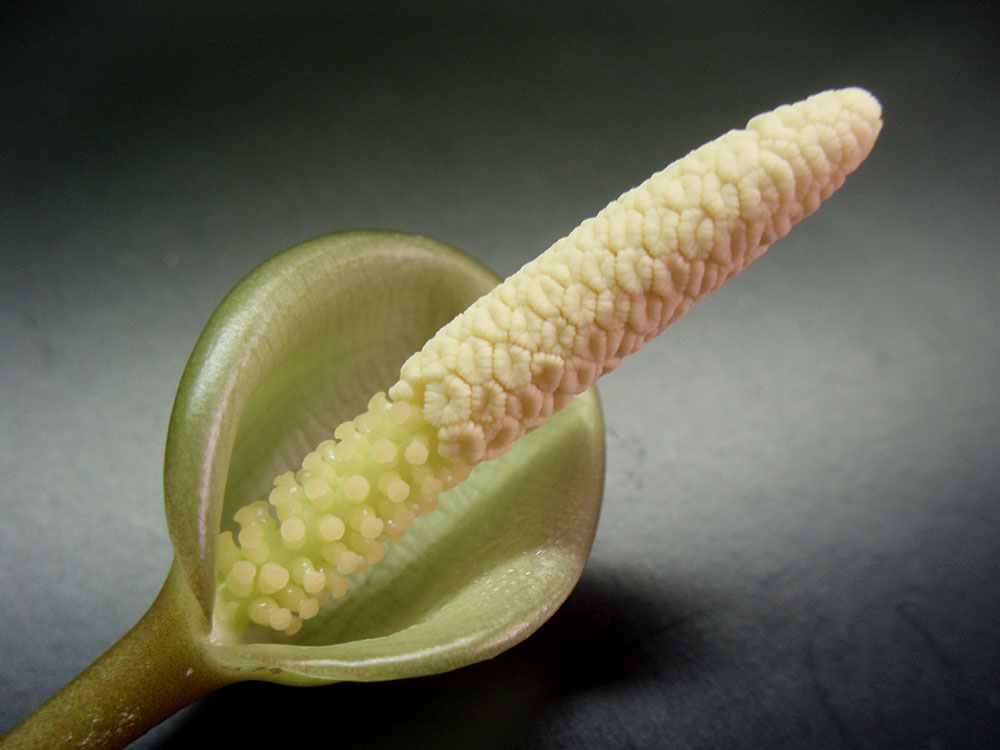
Figure 2. Inflorescence of Anubias heterophylla Engl. The spathe does not limit direct access to female flowers. Photo: D. Loginov.
In contrast, the blooming of Bucephalandra is a more complex process that was described in detail by Malaysian botanists Sin Yeng Wong and Peter Boyce. It begins with the maturation of female flowers (the lower part of the spadix). During this period the spathe opens only a small gap in its upper part. This small hole is enough to allow access of native pollinators (flies from the genus Colocasiomyia), but makes it completely impossible to pollinate the flowers artificially without mechanical removal of the spathe (Fig. 3).
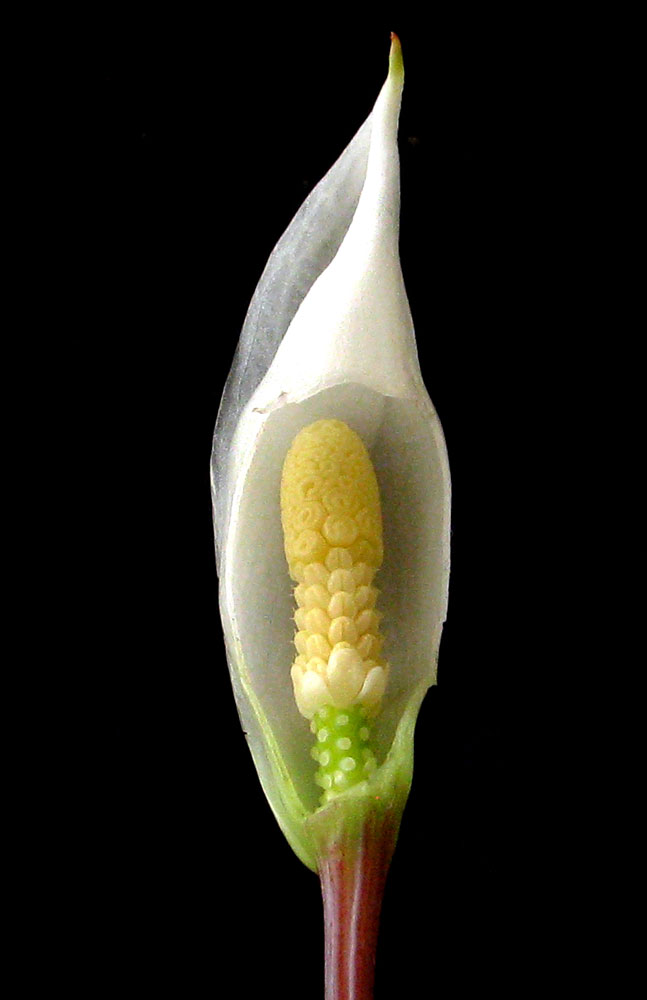
Figure 3. Inflorescence of Bucephalandra bogneri (commercial name is B. sp. Serian) at the beginning of the pistillate anthesis (first day of blooming), part of spathe artificially removed. The interstice staminodes erect to support free access of native pollinators. Photo: S. Bodyagin.
Female flowers stay fertile only for a few hours so do not put the pollination on the long finger. Do not wait until the spathe will start to change further. Remove with a blade a half of the spathe along the axis of the spadix and put pollen on the stigma. The pollen should be taken from another inflorescence. It is important to note that the period of maturation of male and female flowers on the same inflorescence does not overlap. Pollen is usually formed only on the second blooming day, when the female flowers are already unreceptive to it. This process differs significantly from the blooming of Anubias where the cases of self-pollination are well-known. For the transfer of pollen between inflorescences we use paint brushes for watercolor.
The beginning of the pollen maturation is synchronous with a significant separation and destruction of the upper part of the spathe, so you cannot miss this point. The spathe keeps only one part, a lower cup, that covers the female flowers. Pollen grains appear on the horns of the stamens in various forms. Depending on ambient conditions (generally from air humidity), they can have the shape of a drop or a fibre (Fig. 4). Unlike with Anubias, Bucephalandra plants r